IQ visual reasoning gym · 5-question sample
Your result
0 of 5 correct
Time ran out. Only the answers you submitted before then count.
Review
Question 1
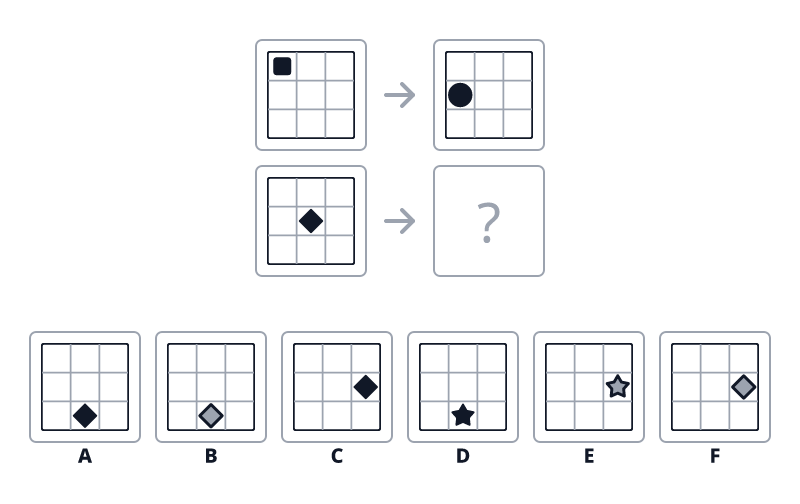
Skipped · incorrect; the answer is D
From the top-left board to the top-right board, three things happen: the shape changes to a different shape, its fill stays the same, and it moves one square down. Make the same three changes to the shape on the bottom-left board. The missing board has a different shape in the same fill, one square below where that shape sits.
Question 2

Skipped · incorrect; the answer is B
Each row and column contains each of the three shapes once and each of the three shadings once. In each row, add the first two counts to get the third. In each column, subtract the second count from the first to get the third. The missing picture therefore contains 3 grey hexagons.
Question 3

Skipped · incorrect; the answer is F
From the top-left board to the top-right board, three things change. The change mirrors the board left to right, so every shape moves to a new square; every fill moves one step along white → grey → black → white (white becomes grey, grey becomes black, black becomes white); and every arrow turns a quarter-turn anticlockwise in its own square. Moving to a new square does not turn an arrow, so its new direction comes from that turn alone. Make all three changes to the bottom-left board to get the missing board.
Question 4

Skipped · incorrect; the answer is F
From the top-left board to the top-right board, two things change. The change mirrors the board left to right, so every shape moves to a new square, and every fill moves two steps along white → grey → black → white (white becomes black, grey becomes white, black becomes grey). Make both changes to the bottom-left board to get the missing board.
Question 5

Skipped · incorrect; the answer is F
In every row, the first two boards make the board after the arrow, in three steps. First, combine them square by square: the result keeps the shapes in squares that only one of the first and second boards uses. Then flip the board top to bottom; the shapes move to new squares but keep pointing the same way. Last, turn every arrow and triangle a quarter-turn anticlockwise in its own square. Do the same with the bottom row's two boards to get the missing board.