IQ visual reasoning gym · 5-question sample
Your result
0 of 5 correct
Time ran out. Only the answers you submitted before then count.
Review
Question 1
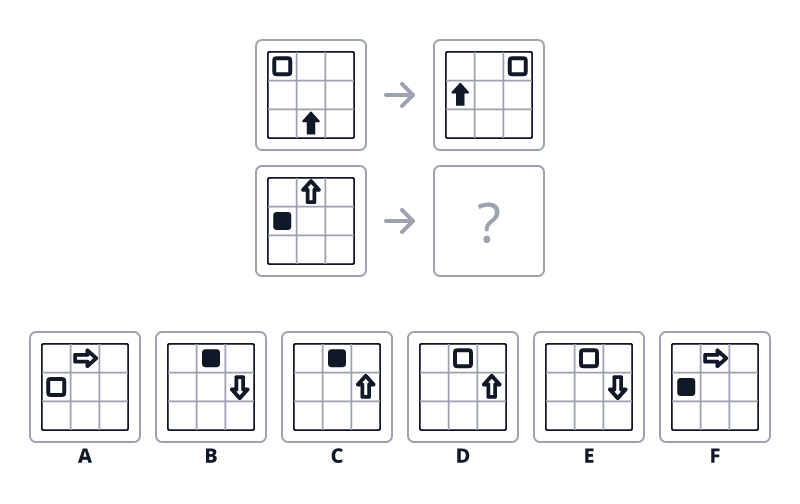
Skipped · incorrect; the answer is C
From the top-left board to the top-right board, the change rotates the board a quarter-turn clockwise. Every shape keeps its shape, its fill and the way it points; only its square changes. Make the same change to the bottom-left board to get the missing board.
Question 2

Skipped · incorrect; the answer is F
From the top-left board to the top-right board, two things change. The change rotates the board a quarter-turn clockwise, so every shape moves to a new square, and every fill moves two steps along white → grey → black → white (white becomes black, grey becomes white, black becomes grey). Make both changes to the bottom-left board to get the missing board.
Question 3

Skipped · incorrect; the answer is F
In every row, the first two boards make the board after the arrow, in two steps. First, combine them square by square: the result keeps only the shapes that are identical, in the same square, on the first and second boards. Then rotate the board a quarter-turn clockwise. Do the same with the bottom row's two boards to get the missing board.
Question 4

Skipped · incorrect; the answer is F
From the top-left board to the top-right board, two things change. The change flips the board top to bottom, so every shape moves to a new square, and every fill moves one step along white → grey → black → white (white becomes grey, grey becomes black, black becomes white). Make both changes to the bottom-left board to get the missing board.
Question 5

Skipped · incorrect; the answer is E
The same rule holds across each row and down each column. Give the first figure a quarter turn clockwise. Give the second figure a quarter turn anticlockwise. Keep strokes that appear in exactly one of the two figures; shared strokes disappear. Combine the bottom row's first two figures, then the right column's first two figures. Both give the same missing figure.