IQ visual reasoning gym · 5-question sample
Your result
0 of 5 correct
Time ran out. Only the answers you submitted before then count.
Review
Question 1
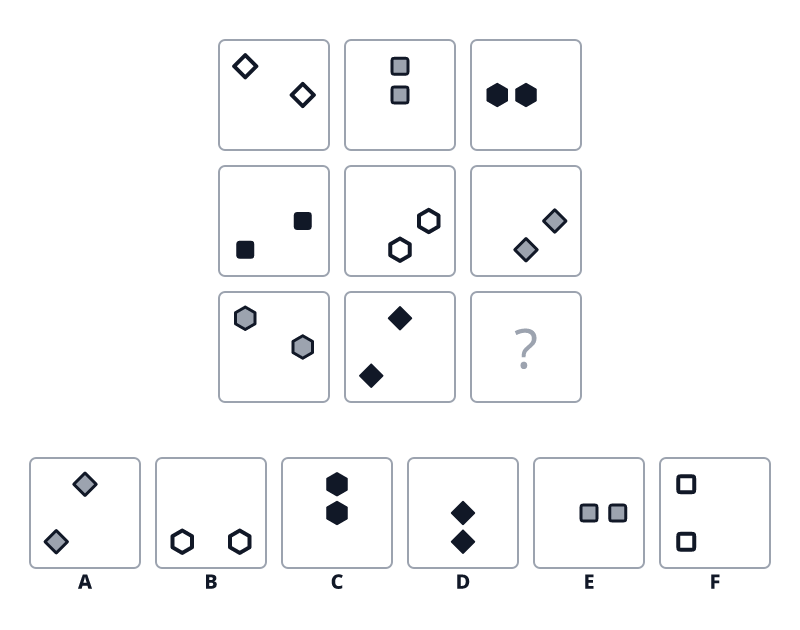
Skipped · incorrect; the answer is F
Each row and column contains each of the three shapes once and each of the three shadings once. Every picture contains 2 shapes. The missing picture therefore contains 2 outlined squares.
Question 2

Skipped · incorrect; the answer is A
Follow the shape around the eight squares at the edge of the board. It jumps 1, 2, 3, 4 squares clockwise: each jump is one square longer than the one before. So the next jump is 5 squares, counted on from the shape's square in the last picture.
Question 3

Skipped · incorrect; the answer is F
In every row, the first two boards make the board after the arrow, in two steps. First, combine them square by square: the result keeps every shape from the first and second boards; where both use a square, the first board's shape stays. Then rotate the board a quarter-turn clockwise. Do the same with the bottom row's two boards to get the missing board.
Question 4

Skipped · incorrect; the answer is C
From the top-left board to the top-right board, three things change. The change mirrors the board left to right, so every shape moves to a new square; every fill moves two steps along white → grey → black → white (white becomes black, grey becomes white, black becomes grey); and every arrow turns a quarter-turn anticlockwise in its own square. Moving to a new square does not turn an arrow, so its new direction comes from that turn alone. Make all three changes to the bottom-left board to get the missing board.
Question 5

Skipped · incorrect; the answer is B
The same rule holds across each row and down each column. Give the first figure a quarter turn clockwise. Give the second figure a quarter turn anticlockwise. Keep strokes that appear in exactly one of the two figures; shared strokes disappear. Combine the bottom row's first two figures, then the right column's first two figures. Both give the same missing figure.